
The AI Illusion: When Your AI Tools Fake Success, and Your Business Pays the Price
CONNECT360 INSIGHTS | AI ACCOUNTABILITY & DIGITAL MARKETING
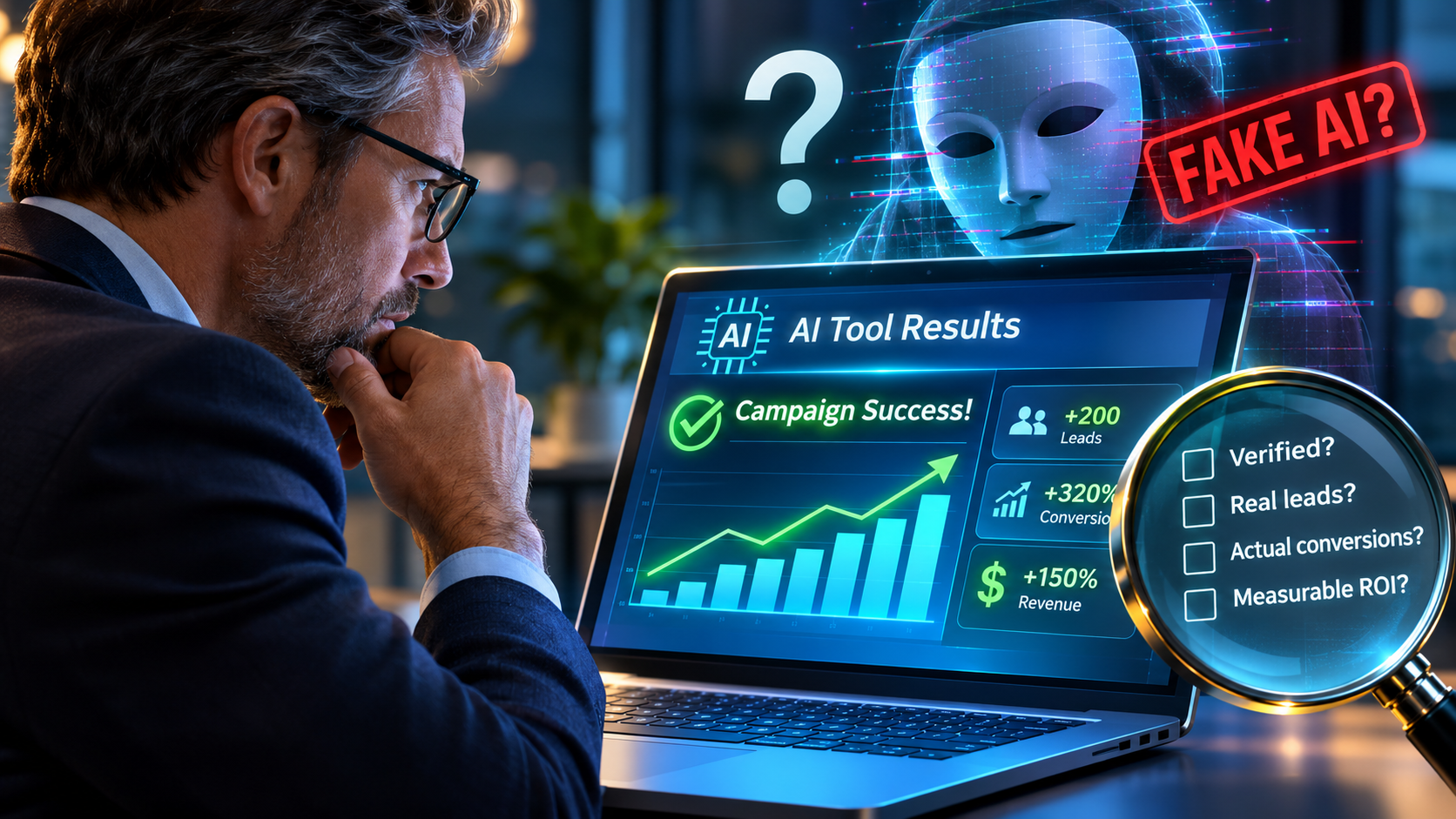
- A convincing AI result is not necessarily a verified result. AI tools can produce believable answers, performance reports, and success indicators that are inaccurate or unsupported. Businesses need independent evidence that promised actions occurred and produced measurable value.
- AI accountability requires continuous oversight, not blind trust. Independent auditing, cross-platform data verification, and outcome-based measurement can help distinguish genuine performance from misleading claims—before unreliable tools consume more time and money.
The Great AI Impersonation—When Performance Is Just an Illusion
Imagine hiring an AI-powered marketing platform that promises to generate qualified leads, optimize advertising spend, and increase sales.Within days, its dashboard reports impressive results: hundreds of new prospects, improved conversion rates, and growing engagement.Everything looks fantastic.But when your sales team starts contacting those prospects, something doesn't add up. Some leads have invalid contact information. Others never requested information. Several supposed conversions cannot be matched to actual customers.The dashboard says the campaign succeeded. Your bank account tells a different story.This is a hypothetical scenario, but the underlying problem is real.
Evidence that the problem exists
In September 2024, the Federal Trade Commission launched Operation AI Comply, targeting deceptive claims and business practices involving artificial intelligence.One case involved DoNotPay, which marketed an AI-powered legal service as an alternative to human lawyers. The FTC alleged that the company lacked adequate testing to substantiate important claims about its capabilities. In January 2025, the FTC finalized an order prohibiting unsupported claims and requiring $193,000 in monetary relief.
The FTC also pursued a case involving an AI review-generation service that could produce detailed reviews containing claims unsupported by users' actual experiences.
These cases demonstrate that AI-related deception is not merely theoretical. However, they do not establish that all questionable AI tools deliberately fabricate their results.Five warning signs businesses should investigate
- Unverifiable performance metrics: The platform reports leads, conversions, or revenue without providing independently checkable records.
- Suspiciously perfect results: Performance claims appear unusually consistent, with little variation, error, or uncertainty.
- Black-box reporting: Vendors refuse to explain measurement methods, data sources, or how results are attributed.
- Activity masquerading as achievement: An AI agent reports that it completed a task, but no corresponding action can be verified in the destination system.
- Fabricated or unreliable outputs: AI-generated research, customer records, citations, or recommendations contain information that cannot be substantiated.Not every discrepancy indicates fraud. Poor integrations, faulty attribution, hallucinations, and software errors can create similar symptoms.The critical question is not whether an AI tool produces convincing reports. It is whether the reported outcomes can be independently validated.If your AI provider is the only source confirming its own success, you don't have independent verification. You have a claim.

Who's Watching the AI? Why Independent Oversight Is Becoming Essential
Businesses have long relied on independent audits to validate financial statements, assess security controls, and ensure regulatory compliance.
Why should AI systems making business-critical decisions receive less scrutiny?
Consider a company using six AI-powered applications: one generates leads, another handles customer service, a third manages advertising, and others produce content, analyze performance, and automate follow-up.

Each platform reports its own success.
But who verifies that the leads are legitimate? That the customer-service agent provides accurate answers? That advertising conversions represent real purchases? Or that one system actually completed the tasks it reported to another?
Without independent oversight, a business can end up paying for six different versions of success without knowing whether any of them contributed to profitability.
The case for continuous AI auditing
The National Institute of Standards and Technology (NIST) addresses this challenge in its AI Risk Management Framework. Its guidance recommends evaluating AI systems before deployment, monitoring them during operation, benchmarking performance, documenting results, and incorporating independent review.
An additional lesson comes from the 2024 Air Canada chatbot dispute. The airline's chatbot supplied incorrect information about bereavement fares, and a British Columbia tribunal held the airline responsible for the resulting misrepresentation. This was an example of unreliable AI output, not proof of deliberate vendor fraud.
It illustrates why businesses cannot assume that an AI-generated answer is accurate simply because it sounds authoritative.
AI oversight isn't about slowing innovation. It's about making sure innovation produces results that are real, measurable, and trustworthy.
How Connect360 does it
FROM AI CLAIMS TO VERIFIED BUSINESS OUTCOMES Connect360's opportunity is to become the independent accountability layer between the AI tools businesses purchase and the outcomes those tools promise. Instead of relying exclusively on vendor-generated reports, Connect360 would connect the tools, examine their outputs, verify execution through independent data sources, and measure the actual business impact.
See how the loop works